Climate management without in-house climate experts.
Understand climate risks, reduce emissions. Guided, audit-ready, in days instead of months.
Four sides are asking for figures, targets and a plan.
The pressure now comes from the market itself. Companies with robust numbers negotiate better. Companies without them pay the price.
Two perspectives on the same problem.
Levve grew out of two working lives that got stuck at the same point.
“As a sustainability officer in a mid-sized company I had the mandate, but no budget, no team and no data. Later I delivered climate transition and climate resilience projects for large corporations, with every resource I needed. Levve closes exactly that gap.”
 Jonas Bettenbühl
Climate strategy & sales · jonas.bettenbuehl@levve.eu
Jonas Bettenbühl
Climate strategy & sales · jonas.bettenbuehl@levve.eu
“I have built CSRD data structures inside large corporations. The methodology has existed for years, it is just packaged unaffordably for mid-sized companies. So we put it into a system that runs the data intake itself.”
 Carolin Berg
AI engineering & product · carolin.berg@levve.eu
Carolin Berg
AI engineering & product · carolin.berg@levve.eu
We hold every intro call ourselves. No call centre, no hold music, no sales script, and an answer within one working day. More about us →
One conversation. Three steps. One audit-ready result.
Guided data intake
Arcas, the AI project manager, asks for what is needed: sites, consumption, business data. Documents such as invoices are read automatically. No prior knowledge required, no empty spreadsheet.
Specialists calculate
A network of specialised AI agents handles accounting, measure research and benchmarking. Climate risks are calculated by a deterministic engine without AI guesswork. Every statement remains traceable to its source.
Strategy & analysis
You receive audit-ready analyses and a strategy with prioritised measures, ready to present to banks, business partners and auditors. The annual licence keeps the data current instead of starting over next year.
Decarbonisation and climate resilience from a single data intake.
Both modules can be booked separately and use the same data foundation. One intake, two analyses, one system that keeps the data.
Climate resilience
Physical and transitional climate risks per site against all climate hazards of the EU Taxonomy, based on real geodata (DWD, Copernicus) and NGFS scenarios. With a clear statement on which sites become critical and when, plus concrete adaptation measures.
This is what you get.
Not an empty, self-configured software subscription and not a one-off slide deck: a guided system that brings emissions, climate risks and strategy together in one place.
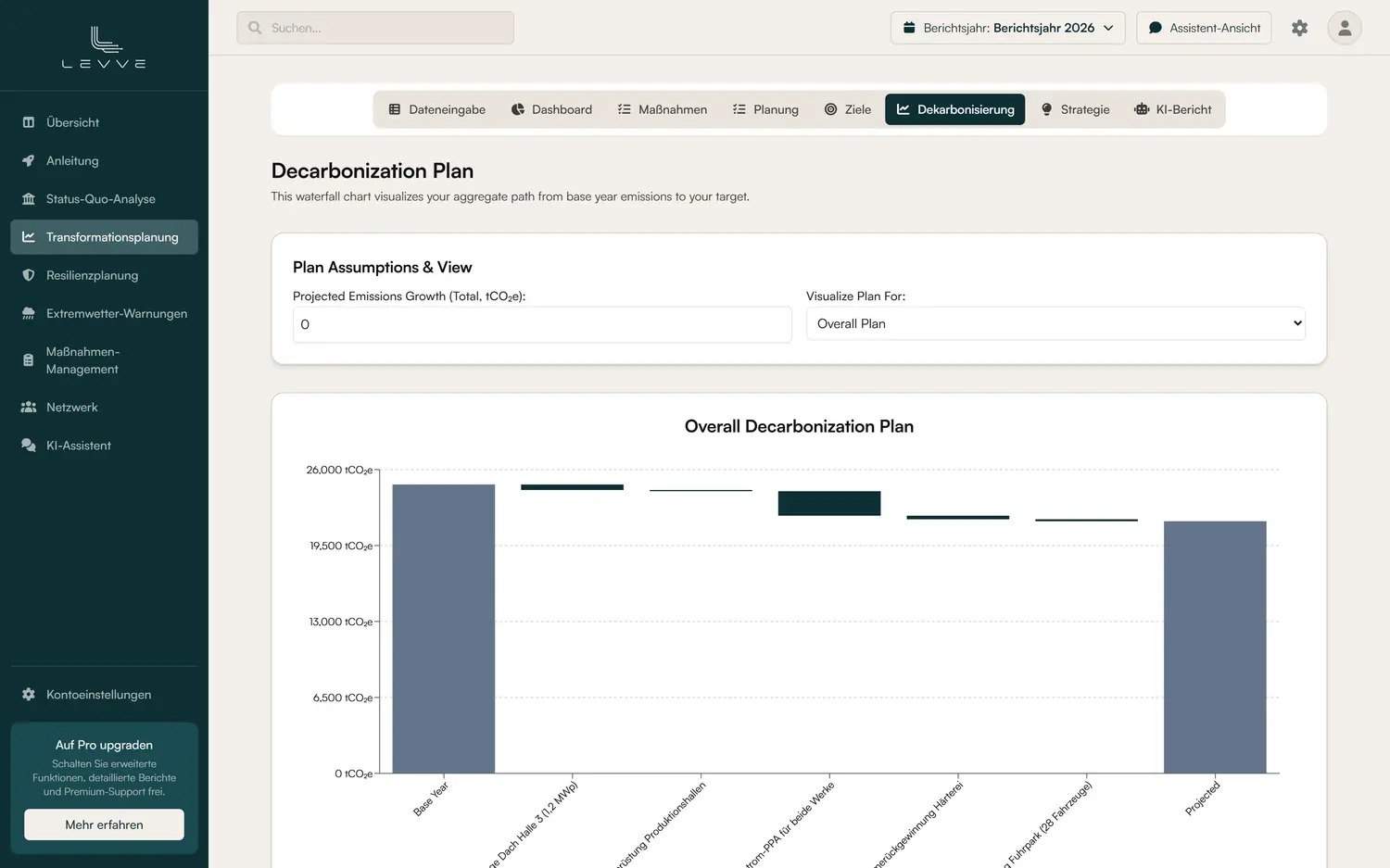
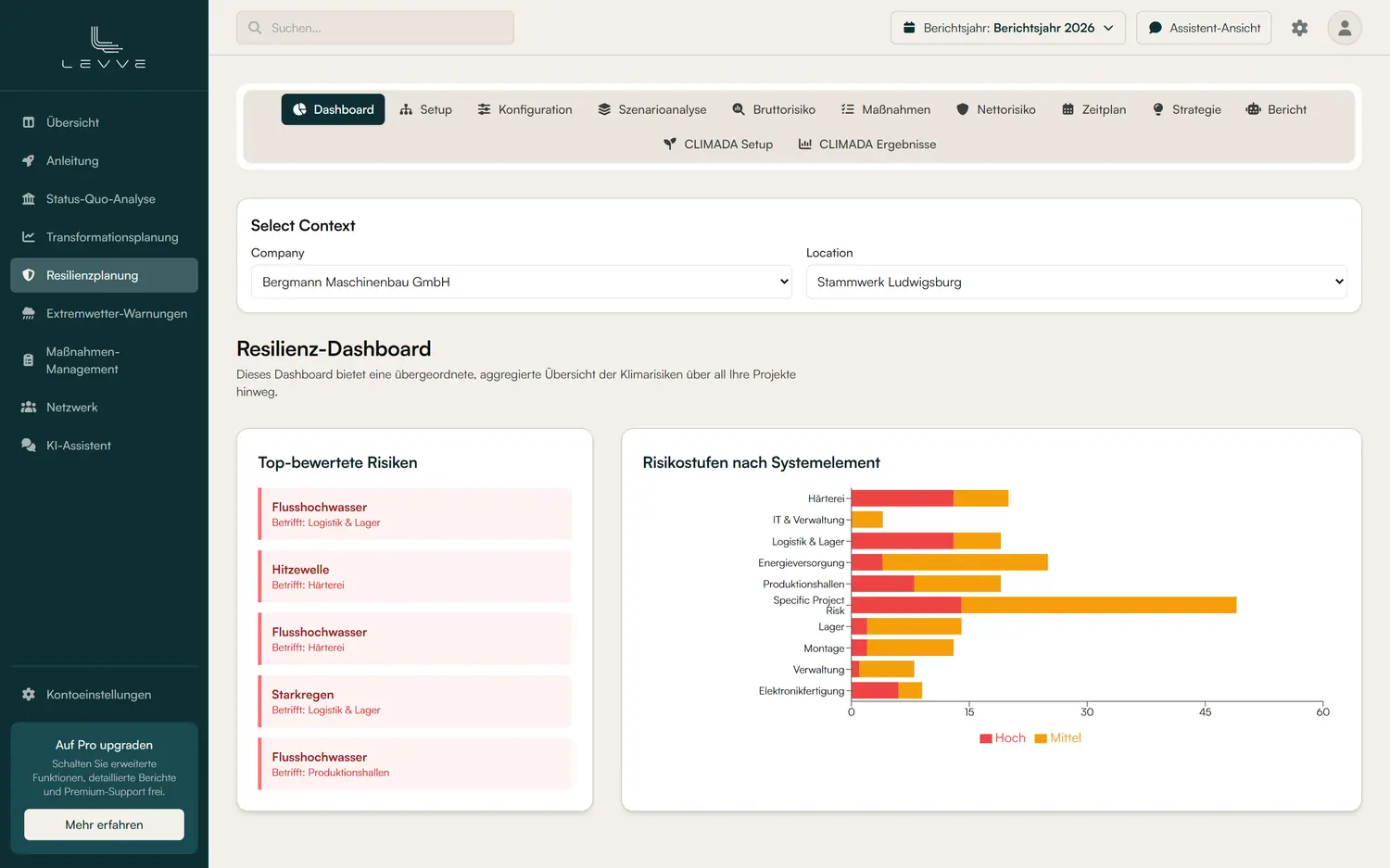
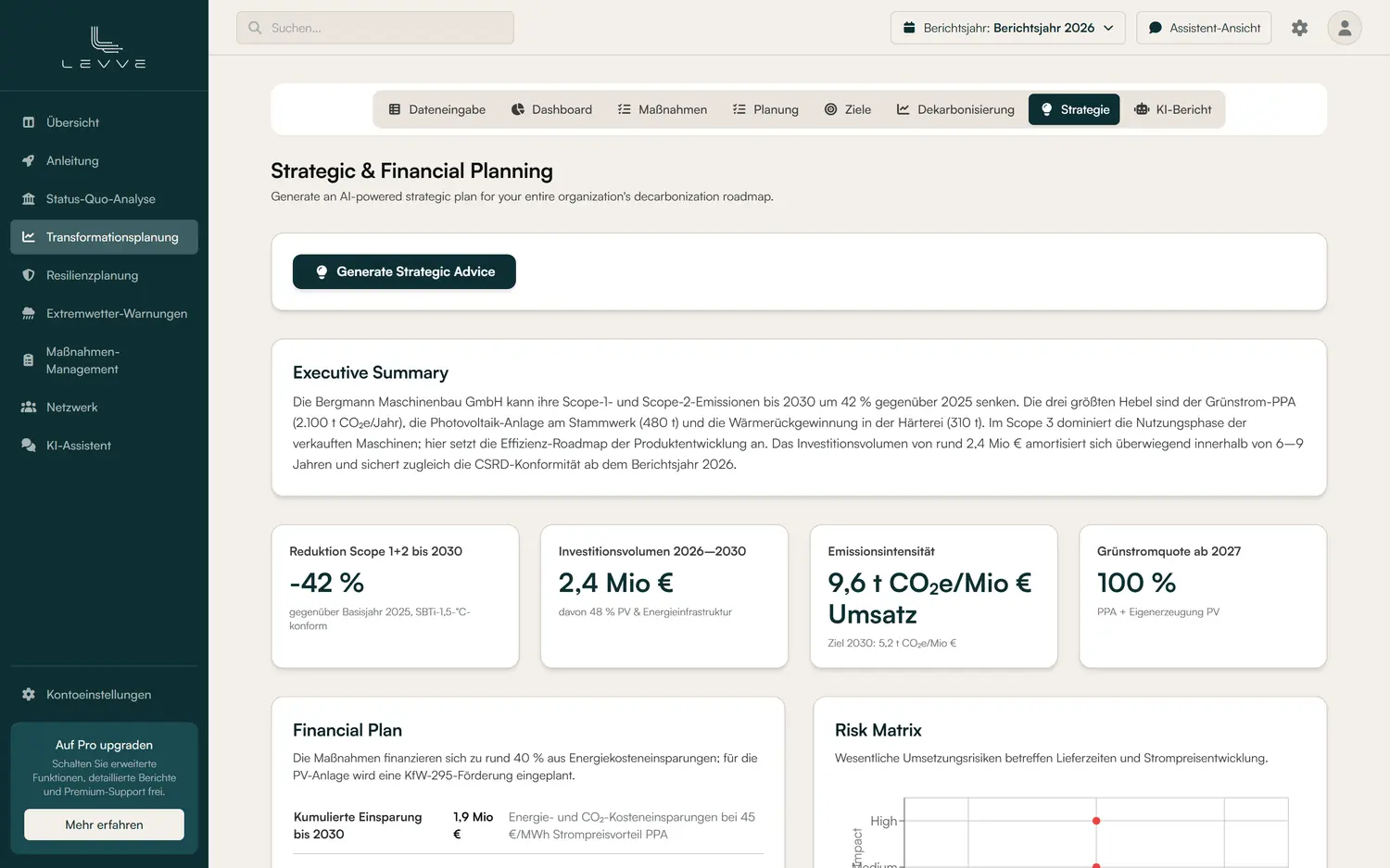
Product view · anonymised sample data of a demo company
Ask Arcas.
Exactly the interface you see in the product, here interactive with a fictional sample company.

Good day.
I am Arcas, the AI climate strategist by Levve. Pick a question and I answer for a fictional sample company, just like in the real product.
Demo · scripted dialogue about a fictional company · no live AI. AI-generated answers are no substitute for professional advice.
Two paths to robust climate data.
You run a mid-sized company.
Your bank, a key account or CBAM demand numbers, and there is no climate team in-house. Levve delivers both analyses at a fixed price.
For mid-sized companies → Banks · Insurers · Development financeYou are responsible for a credit portfolio.
EBA Pillar 3 ESG requires robust portfolio data from the end of 2027, including smaller institutions. Levve collects data at the borrower instead of estimating from country proxies.
For financial institutions →Audit-ready by design, operated in Europe.
Auditable
The core calculation runs deterministically and transparently, with documented sources and decisions. No AI black box: the AI leads the conversation, it does not invent numbers.
EU-sovereign
Processing exclusively on European infrastructure (Scaleway, Mistral AI, Qdrant, Strato). No US cloud provider in the processing path, GDPR-compliant.
Efficient
What a consulting team produces manually in months, Levve delivers in days, with equal or greater methodological depth at a fraction of the cost.
Why not another consulting project?
The market offers three routes today. Each solves only part of the problem.
| Score providers | Classic consulting | Levve | |
|---|---|---|---|
| Data collected at your company | Questionnaire only | Yes, during the project | Yes, guided dialogue |
| Physical climate risk modelled | No | Partly, project-dependent | Yes, deterministic |
| Emissions and risk together | No | Two separate projects | Yes, from one intake |
| Data usable next year | Partly | No, start from scratch | Yes, the system keeps it |
| Time to result | Instant score, no depth | 8 to 16 weeks | Days instead of weeks |
| Cost | Low, low insight | avg. €1,300/day (BDU 2025) | Fixed price from ~€9,000 |
Source: BDU fee study 2025. The provider groups describe typical service profiles, not individual companies.
Frequently asked questions
What is Levve?
Levve is the AI climate strategist for German mid-sized companies. A guided dialogue collects the data inside your company, specialised AI agents analyse it, and a deterministic engine calculates the climate risks. The result: audit-ready analyses and an actionable strategy for your bank, business partners and management.
Do we need in-house climate experts?
No. That is exactly what Levve is built for. The dialogue asks step by step for what is needed, reads documents such as energy bills automatically, and explains every term. Expertise is provided by the system, approval of every step stays with you.
How fast do we get results?
In days instead of months: once the guided data intake is complete, the system calculates and the analysis is produced without weeks of project phases. Comparable consulting projects take 8 to 16 weeks. The concrete date is agreed bindingly in the offer.
What does Levve cost?
During the pilot phase, analyses start at around €9,000 fixed price per module; the annual licence for monitoring and updates starts at €9,500 per year. Booking both modules earns a 15% bundle discount.
Are the results robust enough for our bank?
Yes, that is the core of the product. The core calculation is deterministic and reproducible, every statement is traceable to its source, and results follow recognised frameworks such as the GHG Protocol, TCFD, ESRS E1 and PCAF. The AI leads the conversation; it does not invent numbers.
Where is our data processed?
Exclusively in the EU: cloud infrastructure at Scaleway (France), language models by Mistral AI, hosting at Strato (Germany). No US cloud service sits in the processing path. Details on our Security & data protection page.
Do we even have to report? CSRD no longer applies to us.
Most likely correct: after the Omnibus reform, most mid-sized companies fall outside the CSRD obligation. Today the pressure comes from the market: banks assess climate risks in ratings, OEM customers demand Scope 3 data, CBAM makes input materials more expensive. These requests arrive regardless of any reporting duty.
Let us talk about your starting point.
An intro call takes 30 minutes and clarifies which analysis creates impact first in your case. We reply within one working day.
We are currently onboarding pilot customers with preferential conditions and direct influence on product development.